Use of microresination for the preliminary selection of high productivity genotypes in Pinus cubensis Griseb
Article Sidebar
Main Article Content
Abstract
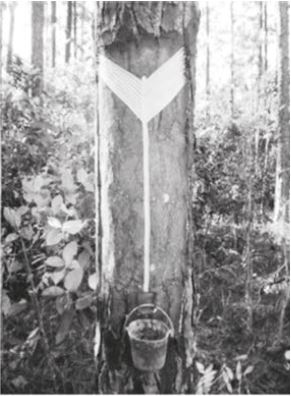
Resin yield of Pinus cubensis Griseb was compared using two methods in Baracoa, Guantánamo, using 25 trees of 21 years old: descending tapping with central canal and micro-tapping. Spearman´s rank correlation coefficient was used to relate both methods; the rank lineal model was obtained to describe the relation between the methods; mean values of each method and regression coefficients were contrasted using Student´s t test, while the model was contrasted using the analysis of variance. All contrasts point out that micro-tapping is a proper method to do preliminary evaluations in order to select genotypes of high resin productivity with that species but, the difference in resin yields between Eastern and Western natural distribution of P. cubensis in the Northwest region of Cuba suggest that, it is necessary to verify those results in other environments before a generalized use of them.
Downloads
Article Details

This work is licensed under a Creative Commons Attribution-NonCommercial 4.0 International License.
Those authors who have publications with this journal accept the following terms of the License Attribution-NonCommercial 4.0 International (CC BY-NC 4.0):
You are free to:
- Share — copy and redistribute the material in any medium or format
- Adapt — remix, transform, and build upon the material
The licensor cannot revoke these freedoms as long as you follow the license terms.
Under the following terms:
- Attribution — You must give appropriate credit, provide a link to the license, and indicate if changes were made. You may do so in any reasonable manner, but not in any way that suggests the licensor endorses you or your use.
- NonCommercial — You may not use the material for commercial purposes.
- No additional restrictions — You may not apply legal terms or technological measures that legally restrict others from doing anything the license permits.
The journal is not responsible for the opinions and concepts expressed in the works, they are the sole responsibility of the authors. The Editor, with the assistance of the Editorial Committee, reserves the right to suggest or request advisable or necessary modifications. They are accepted to publish original scientific papers, research results of interest that have not been published or sent to another journal for the same purpose.
The mention of trademarks of equipment, instruments or specific materials is for identification purposes, and there is no promotional commitment in relation to them, neither by the authors nor by the publisher.
How to Cite
References
Álvarez, A. 1984. Investigaciones para el establecimiento de plantaciones resineras de alta productividad con Pinus caribaea var. caribaea. 120 h. Tesis (en opción al grado científico de Doctor en Ciencias Forestales). Universidad Técnica, Dresde, Alemania.
Álvarez, A. 1991. Variaciones mensuales de los rendimientos en las especies del género Pinus resinadas en Cuba. Boletín Técnico Forestal (CU) 9(2): 45-53.
Álvarez, A., Montalvo, J.M. 1990. El mejoramiento genético de Pinus cubensis. I. Estimaciones de heredabilidad y ganancia genética para la producción de madera. Revista Forestal Baracoa (CU) 20(2): 31-42.
Álvarez, A., Montalvo, J.M. 1991. El mejoramiento genético de Pinus cubensis. II. Evaluación de diferentes alternativas para el aumento de la producción de madera. Revista Forestal Baracoa (CU) 21(2-3): 57-68.
Delgado, M., Álvarez, A., et al. Inédito. Programa de mejoramiento genético forestal de Cuba. Instituto Investigaciones Agro-Forestales. La Habana, Cuba. 300 p.
Eldridge, K. 1973. Normas mínimas para evaluar pruebas de progenies de Pinus radiata. IUFRO S2.03.1. 4 p.
Gardi, C., et al. (eds). 2014. Atlas de suelos de América Latina y el Caribe. Comisión Europea - Oficina de Publicaciones de la Unión Europea, L-2995 Luxembourg. 176 p.
Jiménez, M., Herrero, J.A. 1984. Valoración preliminar de la influencia de los fertilizantes minerales en el crecimiento y desarrollo en una plantación de Pinus caribaea var. caribaea. Revista Forestal Baracoa (CU) 14(2): 7-24.
Mesa, M. 2015. Guía técnica: Tecnología de resinación. La Habana. Instituto Investigaciones Agro-Forestales. Cuba. 75 p.
Mercadet, A., et al. 2001. Introducción de especies y procedencias en Cuba: Resultados de la investigación y proyecciones. Recursos Genéticos Forestales 29: 15-18.
Mesen, F. 1985. Informe sobre el curso de capacitación y la conferencia IUFRO sobre mejoramiento genético de especies forestales. Costa Rica. CATIE. 30 p.
Siegel, S. 1987. Diseño experimental no paramétrico. Instituto Cubano del Libro. Editorial Revolucionarias. p. 233-245.
Sotolongo, P., et al. 1990. Estudio de interacción genotipo-ambiente en pruebas de procedencias de P. cubensis. Boletín Técnico Forestal (CU) 8(2): 23-25.
Yamane, T. 1970. Statistics: An Introductory Analysis. Instituto Cubano del Libro. Editorial Revolucionarias. p. 431-487.