Flora and vegetation of the Eye of Carlos, Ciénaga de la Guayabera, Caguanes National Park
Article Sidebar
Main Article Content
Abstract
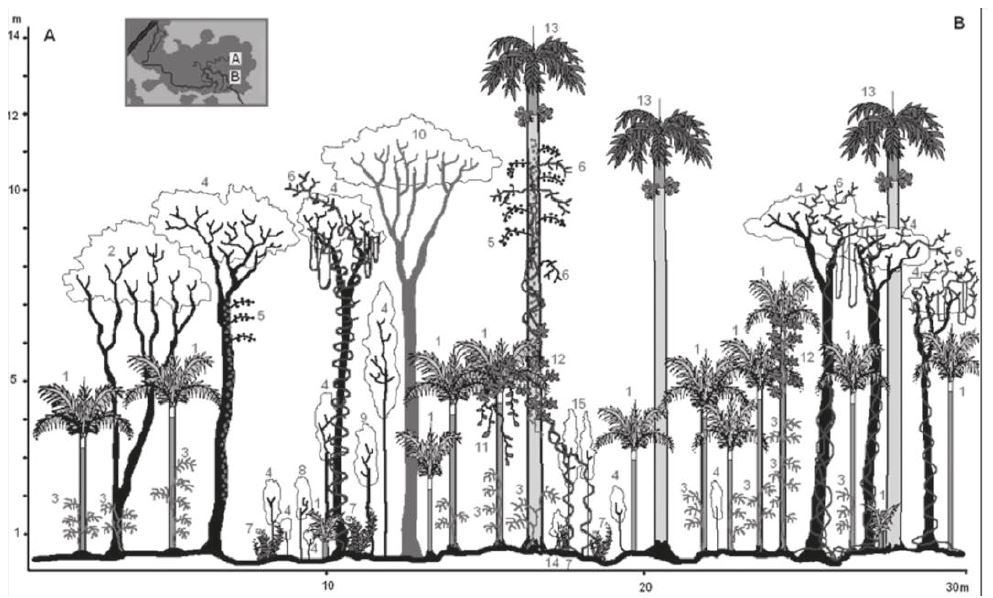
A study of the flora and vegetation of the Ceja de Carlos, in the Cienaga de La Guayabera in areas of the Caguanes National Park is carried out. This is a relic of what were the swamp forests or poor drainage that existed in the fluvial-cumulative plain of the north of the municipality of Yaguajay. In the floristic list 125 plant species were determined, grouped into 57 families and 100 genera. The different vegetation strata were analyzed. Four 20 x 20 m plots were made to find out the composition of tree species in this patch of vegetation and their behavior is analyzed. The tree species with the highest number of individuals were Calophyllum antillanum, Roystonea regia, Lonchocarpus domingensis and Calyptronoma plumeriana.
Downloads
Article Details

This work is licensed under a Creative Commons Attribution-NonCommercial 4.0 International License.
Those authors who have publications with this journal accept the following terms of the License Attribution-NonCommercial 4.0 International (CC BY-NC 4.0):
You are free to:
- Share — copy and redistribute the material in any medium or format
- Adapt — remix, transform, and build upon the material
The licensor cannot revoke these freedoms as long as you follow the license terms.
Under the following terms:
- Attribution — You must give appropriate credit, provide a link to the license, and indicate if changes were made. You may do so in any reasonable manner, but not in any way that suggests the licensor endorses you or your use.
- NonCommercial — You may not use the material for commercial purposes.
- No additional restrictions — You may not apply legal terms or technological measures that legally restrict others from doing anything the license permits.
The journal is not responsible for the opinions and concepts expressed in the works, they are the sole responsibility of the authors. The Editor, with the assistance of the Editorial Committee, reserves the right to suggest or request advisable or necessary modifications. They are accepted to publish original scientific papers, research results of interest that have not been published or sent to another journal for the same purpose.
The mention of trademarks of equipment, instruments or specific materials is for identification purposes, and there is no promotional commitment in relation to them, neither by the authors nor by the publisher.
How to Cite
References
Alain, Hno. 1964. Flora de Cuba. Vol. 5. La Habana. Asociación de Estudiantes de Ciencias Biológicas. 362 p.
Capote, R., Berazaín, R. 1984. Clasificación de las formaciones vegetales en Cuba. Revista Jardín Botánico Nacional (CU) 5(2): 27-75.
Falcón, A., García-Lahera, J.P., Hernández, N.V. 2015. Nuevas localidades para Maxonia apiifolia (Dryopteridaceae) en Sancti Spíritus, Cuba. Revista Cubana de Ciencias Biológicas (CU) 5(1): 23-31.
Falcón, A., Junco, J.Z., Domínguez, A.Z., et al. 2015. Flora y vegetación de Lomas de La Canoa, Reserva de la Biosfera Buenavista, Cuba. Revista Cubana de Ciencias Forestales (CU) 3: 57-71.
García-Lahera, J.P., et al. 2013. Descubrimiento de Maxonia apiifolia (Dryopteridaceae) en el Parque Nacional “Caguanes”, Sancti Spíritus (Cuba). Bissea (CU) 7(2): 2.
León, Hno. y Hno. Alain. 1951. Flora de Cuba. Vol. 2. Contribuciones Ocasionales. Museo Historia Natural Colegio de La Salle, No. 10. La Habana. Impreso P. Fernández y Cía. 456 p.
---------- 1953. Flora de Cuba. Vol. 3. Contribuciones Ocasionales. Museo Historia Natural Colegio de La Salle, No. 13. La Habana. Impreso P. Fernández y Cía. 502 p.
---------- 1957. Flora de Cuba. Vol. 4 Contribuciones Ocasionales. Museo Historia Natural Colegio de La Salle. No. 16. La Habana. Impreso P. Fernández y Cía. 556 p.
Matos, J. 2006. Manual de manejo de flora silvestre. Santa Clara. Editorial Feijoo. 229 p.
Rodríguez-Cala, D., et al. 2018. Re-localización y estado de conservación del helecho amenazado Maxonia apiifolia (Dryopteridaceae) en el humedal sur de La Habana, Cuba. 217: 227-238.