Biomass and retained carbon in a forest farm of the xerophytic runner, Guantánamo, Cuba
Article Sidebar
Main Article Content
Abstract
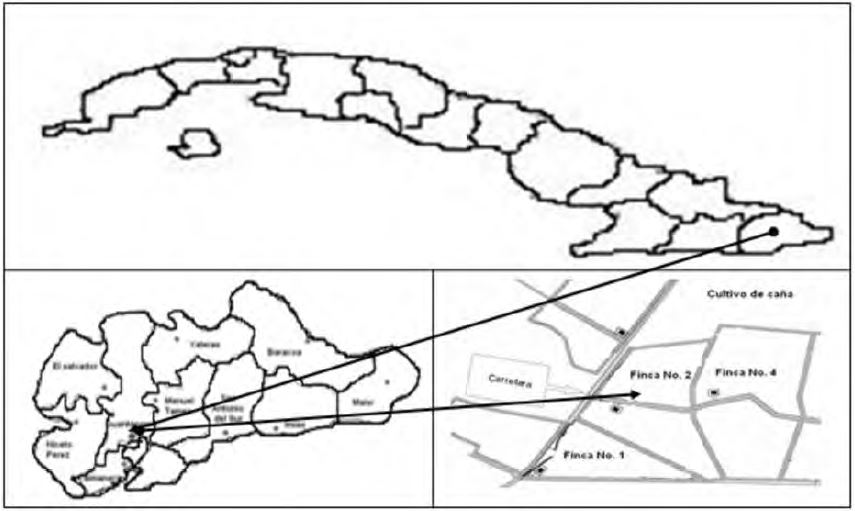
The contribution is quantified in carbon retention of the existent plantations in the Forest Integral Farm. 2, belonging to the Agroforestry Enterprise Guantanamo. Temporary sample parcels of sampling of 375 m2 rose in plantations of Lysiloma latisiliquum (L.) Benth, Albizia lebbeck (L.) Benth. Coulteria linnaei (Griseb.) Acev.- Rodr. y Leucaena leucocephala (Lam.) de Wit., the heights and the diameters were measured from all the trees to 1,30 m on the level of the floor, you calculation the half height and height diameter and the volume. Later the carbon quantified retained by components. Concludes that the retained carbon ascends 232,70 t of carbon, reflected in the its biggest quantity in the soil, with a dear of 216,94 t, being Leucaena leucocephala (Lam.) of Wit. and Albizia lebbeck (L.) Benth. the species that obtained the biggest values in the estimate of the total biomass, for components and retained total carbon.
Downloads
Article Details

This work is licensed under a Creative Commons Attribution-NonCommercial 4.0 International License.
Those authors who have publications with this journal accept the following terms of the License Attribution-NonCommercial 4.0 International (CC BY-NC 4.0):
You are free to:
- Share — copy and redistribute the material in any medium or format
- Adapt — remix, transform, and build upon the material
The licensor cannot revoke these freedoms as long as you follow the license terms.
Under the following terms:
- Attribution — You must give appropriate credit, provide a link to the license, and indicate if changes were made. You may do so in any reasonable manner, but not in any way that suggests the licensor endorses you or your use.
- NonCommercial — You may not use the material for commercial purposes.
- No additional restrictions — You may not apply legal terms or technological measures that legally restrict others from doing anything the license permits.
The journal is not responsible for the opinions and concepts expressed in the works, they are the sole responsibility of the authors. The Editor, with the assistance of the Editorial Committee, reserves the right to suggest or request advisable or necessary modifications. They are accepted to publish original scientific papers, research results of interest that have not been published or sent to another journal for the same purpose.
The mention of trademarks of equipment, instruments or specific materials is for identification purposes, and there is no promotional commitment in relation to them, neither by the authors nor by the publisher.
How to Cite
References
Alfaro, M. 1997. Almacenamiento y fijación de carbono en ecosistemas forestales. Forestal Centroamericana (CR) 19(6): 9-12.
Álvarez, A. 2010. Preparación de la versión 3.0 del sistema SUMFOR: Densidad de la madera. Informe Final de Resultado, Subproyecto 11.69.03: La mitigación del cambio climático por los bosques cubanos, Proyecto. 11.69: Segunda Comunicación Nacional de Cambio Climático: Subsector Forestal, Instituto de Investigaciones Forestales, La Habana. 20 p.
Bentham, G. 1844. Albizia lebbeck (L.) Benth. Hooker’s London Journal of Botany (GB) 3(87): 153-57.
Bolin, B., Sukamar, K. 2000. En: Kanninen, M. 2001. Bosques tropicales y ciclo de Carbono. CATIE. Curso Internacional “Proyecto de Cambio Climático en los Sectores Forestal y Energético. Oportunidades de Desarrollo para los países Latinoamericanos”. CATIE-PNUD, Costa Rica, 24-28 septiembre.
Brown, S. 2002. Measuring carbon in forests: current status and future challenges. Environmental Pollution 116: 363-372 [en línea]. Disponible en: http: //www.winrock.org/ecosystems/ files/2002ForestCarbon.pdf [Consulta: 10 de marzo 2010].
De Camino, R.V., Alfaro, M.M., Sage, L.F.M. 2002. Teak (Tectona grandis) in Central America, Forest Plantations Working Papers. Roma, Italia. FAO. 64 p.
Harmon, M.E., Krankina, O.N., Yatskov, M., Matthews, E. 2001. Predicting broadscale carbon stores of woody detritus from plot-level data. p. 533-552. En: Lal, R., Kimble, J., Stewart, B.A. Assessment Method for Soil Carbon, CRC Press, New York.
InfoStat, versión 2012. Universidad Nacional de Córdoba. Argentina.
IPCC (Panel Intergubernamental de Cambio Climático). 2013. Resumen para responsables de políticas. En: Stocker, T.F., Qin, D., Gian-Kasper, P., Tignor, M.M.B., Allen, S.K., Boschung, J., Nauels, A., Xia, Y., Bex, V., Midgley, P.M. Cambio Climático 2013: Bases físicas. Contribución del Grupo de trabajo al Quinto Informe de Evaluación del Grupo Intergubernamental de Expertos sobre el Cambio Climático” Cambridge University Press, Cambridge, Reino Unido y Nueva York, NY, Estados Unidos de América.
Jandl, R. 2003. Secuestro de carbono en bosques. El papel del suelo. Forestal Iberoamericana (VE) 1 (1): 57-62.
Loguercio, G.A. 2002. Fijación de carbono: Un beneficio adicional para proyectos forestales en Patagonia. Patagonia Forestal (AR) 8 (2): 45.
Mercadet, A., Álvarez, A. 2009. Metodología para establecer la línea base de retención de carbono en las Empresas Forestales Integrales de Cuba. En: Ortega, F., Fernández, L., Volpedo, A. Efecto de los cambios globales sobre el ciclo del carbono. RED CYTED 406RT0285. Efecto cambios globales sobre los humedales de Iberoamérica. p. 107-118.
Mercadet, A., Álvarez, A., Escarré, A., Ortiz, O. 2011. Coeficientes de carbono y nitrógeno en la madera y corteza de especies forestales arbóreas cubanas [en línea]. Disponible en: http://bva.fao.cu/pub_doc/Reposit/cuf0337s.pdf [Consulta: 30 de abril 2012].
Normal Ramal 595. 1982. Tratamientos silviculturales. Cuba. Ministerio de la Agricultura. 25 p.
Pardos, J.A. 1999. Ante un cambio climático: papel de los montes arbolados y los productos forestales en la retención del carbono. Investigación Agraria: Sistema de Recursos Forestales: fuera de serie (ES) 1: 93-99, diciembre.
Pimienta, Dorian de J., et al. 2007. Estimación de biomasa y contenido de carbono de Pinus cooperi Blanco, en Pueblo Nuevo, Durango. Madera y Bosques (MX) 13 (1): 35-46.
Ramírez, O.A., Gómez, M. 1999. Estimación y valoración económica del almacenamiento de carbono. Forestal Centroamericana (CR) (27): 17-22, julio-septiembre.
Sánchez, R. 2008. Informe de suelo realizado a tres Fincas Forestales Integrales (1, 2, 3) de Paraguay, Guantánamo. Centro Provincial de Suelos, Guantánamo, Cuba. 10 p. (Inédito).
Segura, M. 2001. Estimación de carbono en ecosistemas tropicales: los aportes de modelos de biomasa. Curso Internacional Proyecto Cambio Climático en los Sectores Forestales y Energético: Oportunidades de desarrollo para países latinoamericanos (CATIE-PNUD, 24-26 septiembre: Turrialba) Costa Rica.
Toirac, W., et al. 2013. Respuesta de la aplicación de la técnica de forestería análoga en Fincas Forestales Integrales, Guantánamo, Cuba. Tercer Congreso Latinoamericano de IUFRO (CATIE, 12-15 junio: San José) Costa Rica. 8 p.
Zárate, S. 1987. Revisión del género Leucaena en México.
Anales del Instituto biología, UNAM. Serie Botánica (MX) 65 (2): 83-162.