Formulation of the evapotranspirative deficiency index. A tool for the studies of evolution of the aridity
Article Sidebar
Main Article Content
Abstract
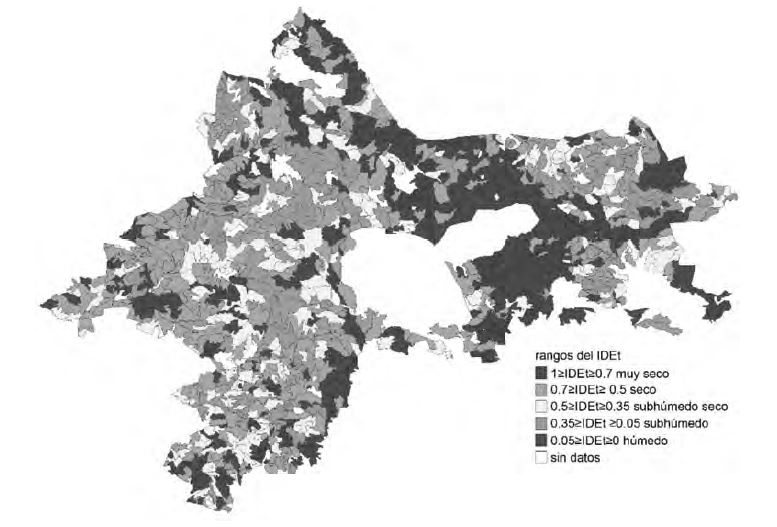
The combination of the increase in temperature and the decrease of the precipitations has been identified as the main impact of the climatic change on the forest species and formations of Mediterranean distribution in the province of Camagüey. Nevertheless to be measured in an independent way, both variables act to the unison on the agricultural and forest systems and they propitiate different categories of aridity. Based on the equations of the abiotic sub model of the model ForClim of Bugmann and Solomon (2000) and Bugmann and Cramer (1998) an edaphoclimatic index (IDEt) was formulated. The IDEt determines the rate of both annual and monthly evapotranspirative deficiency of a unit of real soil, adding to the climatological parameters, the variable field capacity and effective depth of the soil.
Downloads
Article Details

This work is licensed under a Creative Commons Attribution-NonCommercial 4.0 International License.
Those authors who have publications with this journal accept the following terms of the License Attribution-NonCommercial 4.0 International (CC BY-NC 4.0):
You are free to:
- Share — copy and redistribute the material in any medium or format
- Adapt — remix, transform, and build upon the material
The licensor cannot revoke these freedoms as long as you follow the license terms.
Under the following terms:
- Attribution — You must give appropriate credit, provide a link to the license, and indicate if changes were made. You may do so in any reasonable manner, but not in any way that suggests the licensor endorses you or your use.
- NonCommercial — You may not use the material for commercial purposes.
- No additional restrictions — You may not apply legal terms or technological measures that legally restrict others from doing anything the license permits.
The journal is not responsible for the opinions and concepts expressed in the works, they are the sole responsibility of the authors. The Editor, with the assistance of the Editorial Committee, reserves the right to suggest or request advisable or necessary modifications. They are accepted to publish original scientific papers, research results of interest that have not been published or sent to another journal for the same purpose.
The mention of trademarks of equipment, instruments or specific materials is for identification purposes, and there is no promotional commitment in relation to them, neither by the authors nor by the publisher.
How to Cite
References
ACC. 1989. Atlas de Camagüey. Instituto de Geografía / Instituto Cubano de Geodesia y Cartografía. La Habana. Academia de Ciencias de Cuba. 114 p.
Allen, R.G., Pereira, L.S., Raes, D., Smith, M. 1998. Crop evapotranspiration. FAO Irrigation and Drainage Paper No. 56. Rome. FAO. 300 p.
Bugmann, H., Solomon, A. 2000. Explaining forest composition and biomass across multiple biogeographical regions. Ecological Applications (US) 10(1):95-114.
Bugmann, H., Cramer, W. 1998. Improving the behaviour of forests gaps models along drought gradients. Forest Ecology an Management (NL) 103: 247-263.
Instituto de Suelos (IS). 1988. Mapa de suelos de Camagüey. Segunda clasificación genética de los suelos de Cuba. Camagüey. UCTB Suelos Camagüey.
Markesteijn, L. 2010. Drought tolerance of tropical tree species; functional traits, trade-offs and species distribution. PhD. Thesis, Wageningen University, Wageningen, NL. ISBN 97890-8585-534-7: 204 p.
Narasimhan B., Srinivasan, R. 2005. Development and evaluation of Soil Moisture Deficit Index (SMDI) and Evapotranspiration Deficit Index (ETDI) for agricultural drought monitoring. Agricultural and Forest Meteorology (NL) 133: 69-88.
Rivero, R.E. 2008. Workbook on climate change impact assessment in agriculture. Basic knowledge, methodologies and tools. ISBN 978-976-95260-1-3. 142 p.
Sellers, W.D. 1965. Physical Climatology. Chicago. University Press. 272 p.