State of the protective plantations of Bambusa vulgaris in three sites of the Great Metropolitan Park of Havana
Article Sidebar
Main Article Content
Abstract
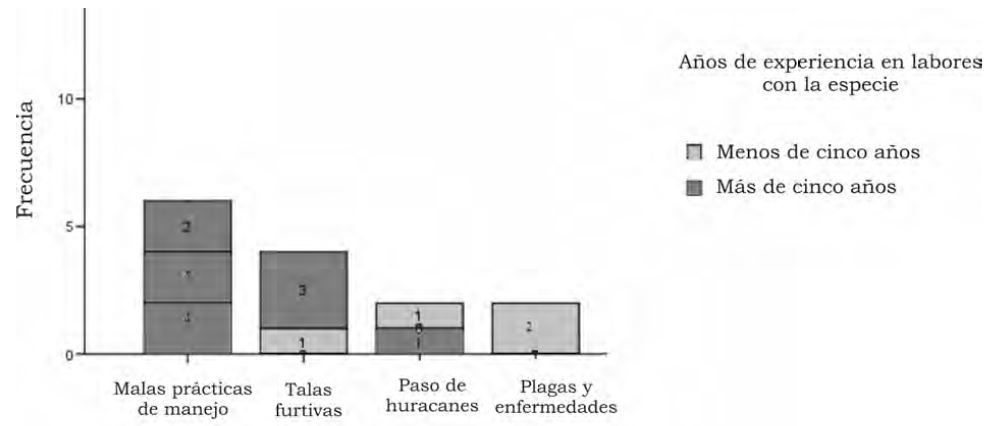
Bambusa vulgaris Schrader ex Wendland kind of a great importance for the town for their uses. The work was executed in three areas of the strip forest hidrorreguladora of the Stream Santoyo, Forest of Pogolotti and Property of Adalberto Morejón and near to the river Almendares that of the Bank bamboo Germoplasma in the town Screw, belonging to the Great Metropolitan Park of Havana. With the objective of knowing the state of the plantations protectors of the species the grafts were evaluated from the year 2005 - 2015. A methodology is used for the approaches of evaluation of the current state of conservation of the culmos and the questionnaire of type grupal. The results in this areas threw a valuation of regulating, he/she was proven the structure regular and bad handling practices in the grafts what causes the main deterioration of the species: “Bad handling practices”, with a high ponderación.
Downloads
Article Details

This work is licensed under a Creative Commons Attribution-NonCommercial 4.0 International License.
Those authors who have publications with this journal accept the following terms of the License Attribution-NonCommercial 4.0 International (CC BY-NC 4.0):
You are free to:
- Share — copy and redistribute the material in any medium or format
- Adapt — remix, transform, and build upon the material
The licensor cannot revoke these freedoms as long as you follow the license terms.
Under the following terms:
- Attribution — You must give appropriate credit, provide a link to the license, and indicate if changes were made. You may do so in any reasonable manner, but not in any way that suggests the licensor endorses you or your use.
- NonCommercial — You may not use the material for commercial purposes.
- No additional restrictions — You may not apply legal terms or technological measures that legally restrict others from doing anything the license permits.
The journal is not responsible for the opinions and concepts expressed in the works, they are the sole responsibility of the authors. The Editor, with the assistance of the Editorial Committee, reserves the right to suggest or request advisable or necessary modifications. They are accepted to publish original scientific papers, research results of interest that have not been published or sent to another journal for the same purpose.
The mention of trademarks of equipment, instruments or specific materials is for identification purposes, and there is no promotional commitment in relation to them, neither by the authors nor by the publisher.
How to Cite
References
Álvarez, M. et al. 2003. Tecnología para el manejo sostenible de Bambusa vulgaris Schrad. En: Memorias del Primer Taller Nacional del Bambú. Programa “Desarrollo de alternativas agroecológicas para el uso del bambú en Cuba”. Asociación Cubana de Trabajadores Agropecuarios y Forestales. p. 39-51.
Baena, M., Larillo, S., Montoya, J.E. 2003. Material de apoyo a la capacitación en Conservación in situ de la diversidad vegetal en áreas protegidas y fincas. Instituto Internacional de Recursos Filogenéticos (IPGRI). Material producido con el apoyo del Instituto Nacional de Investigaciones y Tecnología Agraria y Alimentación de España (INIA). p.20.
Betancourt, M. et al. 2008. Reforestación con Bambú en Cuba. Memorias del taller Bambú biomasa, Bayamo, Granma. Versión electrónica. p.14.
Calero, A. 1978. Técnicas de muestreo. Estadística. Ciudad de La Habana. Editorial Pueblo y Educación. 184 p.
Catasús, L. 2003. Estudio de los Bambúes arborescentes cultivados en Cuba. Asociación Cubana de Trabajadores Agropecuarios y Forestales. 56 p.
Cordero, E.M. 2014. Estado de las plantaciones protectoras de bambusa vulgaris schrader ex wendland en el Río Cuyagüateje. Revista Forestal Baracoa (CU) 33(2): 3-8.
García, Q.Y. 2006. Estrategia de conservación intraespecífica para Pinus caribaea Morelet var. caribaea Barret y Golfari. 178 h. Tesis (en opción al grado científico de Doctor en Ciencias Ecológicas. Universidad de Pinar del Río/Universidad de Alicante.
Gran Parque Metropolitano de La Habana. 2015. Registros del Equipo Técnico. Estudio sobre el cálculo de áreas de bambú en el Gran Parque Metropolitano de La Habana. La Habana. Cuba. 1 p.
Gutiérrez, B. 2003. Enfoque cooperativo para el mejoramiento genético y la conservación de los recursos forestales en Chile, Colombia y Costa Rica [on line]. Investigación Agraria. Sistema y Recursos Forestales (ES) 12(3):113.
Hernández, A. et al. 1999. Nueva versión de clasificación genética de los suelos de Cuba. Ciudad de La Habana. Instituto de Suelos. 64 p.
INSMET. 2013. Conferencia impartida sobre el clima de Cuba. La Habana.
Notario Castro, A. 1999. Apuntes de metodología de la investigación científica. Documento preparado para la Maestría en Ciencias Forestales. Dpto. Forestal. Universidad de Pinar del Río “Hnos. Saíz Montes de Oca”. 63 p.
Prabhu, R., Colfer, C.J.P., Dudley, R.G. 1999. Guidelines for developing, testing and selecting criteria, and indicators for sustainable forest management. The criteria and indicators Toolbox Series No. 1. Indonesia. CIFOR. 186 p.
Surós, R.E. 2005. Bases teóricos metodológicos para determinar las dimensiones de las Unidades de Base. Estudio de caso: Unidad Macurije. 93 h. Tesis (en opción al grado científico de Doctor en Ciencias Forestales. Universidad de Pinar del Río.
Wong, K.M. 1995. The Bamboos of Penunsular Malaysia, Malayan Forest Records, No. 41, 200 p.