Epiphyte orchids as indicative species of disturbances in the west sector of the Biosphere Reserve Sierra del Rosario
Article Sidebar
Main Article Content
Abstract
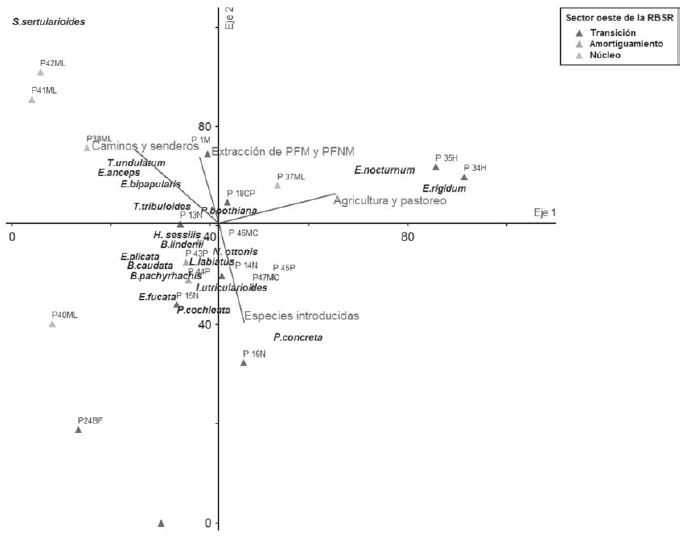
The present research was carried out with the aim of determining the epiphyteorchid species indicative of disturbed forests in the biosphere reserve Sierra del Rosario” (RBSR). Three areas were selected of the west sector in which 47 parcels of 500 m2 were settled down (50 m x 10 m), in a systematic way, regarding the sections: base, middle and summit; the four cardinal points: North (N), South (S), This (E) and West (W); and the accessibility of each one of the sampling places. The response variables were used by the selection of the indicative species taking into consideration the established approaches such as: species which occupy more than 5 % of the area, tree diversity and the influence of man disturbances. The pattern of indicative species according to the established variables was associated to the species Prosthechea boothiana and Polystachya concreta.
Downloads
Article Details

This work is licensed under a Creative Commons Attribution-NonCommercial 4.0 International License.
Those authors who have publications with this journal accept the following terms of the License Attribution-NonCommercial 4.0 International (CC BY-NC 4.0):
You are free to:
- Share — copy and redistribute the material in any medium or format
- Adapt — remix, transform, and build upon the material
The licensor cannot revoke these freedoms as long as you follow the license terms.
Under the following terms:
- Attribution — You must give appropriate credit, provide a link to the license, and indicate if changes were made. You may do so in any reasonable manner, but not in any way that suggests the licensor endorses you or your use.
- NonCommercial — You may not use the material for commercial purposes.
- No additional restrictions — You may not apply legal terms or technological measures that legally restrict others from doing anything the license permits.
The journal is not responsible for the opinions and concepts expressed in the works, they are the sole responsibility of the authors. The Editor, with the assistance of the Editorial Committee, reserves the right to suggest or request advisable or necessary modifications. They are accepted to publish original scientific papers, research results of interest that have not been published or sent to another journal for the same purpose.
The mention of trademarks of equipment, instruments or specific materials is for identification purposes, and there is no promotional commitment in relation to them, neither by the authors nor by the publisher.
How to Cite
References
Arditti, J. 1992.Fundamentals of Orchid Biology. John Wiley & Sons. 672 p.
Barthlott, W. et al. 2001. Diversity and abundance of vascular epiphytes: a comparison of secondary vegetation and primary montane rain forest in the Venezuelan Andes. Plant Ecology (NL) 152: 145-156.
Braun-Blanquet, J., 1979. Fitosociología. Bases para el estudio de las comunidades vegetales. H. Blume Ediciones. 820 p.
Caro, T.M. 2000. Focal species. Conservation Biology (US) 14:1569-1570.
Carpenter, S., et al. 2001. From metaphor to measurement: resilience of what to what? Ecosystems 4:765-781.
Estévez, R. E. 2005. Inventario de orquídeas epífitas del bosque latifoliado maduro de la Altura de Linaca, El Paraíso, Honduras. Revista Zamorano (HN) (3): 1-10. Diciembre.
Favreau, J., et al. 2006. Recommendations for assessing the effectiveness of surrogate species approaches. Biodiversity and Conservation (Springer Netherlands) 15: 3949-3969.
Feinsinger, P. 2004. El diseño de estudios de campo para la conservación de la Biodiversidad. Bolivia. Editorial FAN. p. 31-164
Ferro, J. 2004. Efectos del aprovechamiento forestal sobre la estructura y dinámica de la comunidad de epífitas vasculares del bosque semideciduo notófilo de la península de Guanahacabibes. 107h. Tesis (en opción al grado científico de Doctor en Ciencias Forestales). Universidad de Pinar del Río. Cuba.
Garibaldi, C. 2008. Efectos de la extracción y uso tradicional de la tierra sobre la estructura y dinámica de bosques fragmentados en la Península de Azuero, Panamá. 110 h. Tesis (en opción al grado científico de Doctor en Ciencias Forestales). Universidad de Pinar del Río, Cuba.
Gentry, A. H., Dodson, C. H. 1987. Diversity and biogeography of neotropical vascular epiphytes. Annals of the Missouri Botanical Garden (US) 74: 205-233.
Guariguata, M. R., kattan, G. H. 2002. Ecología y conservación de bosques neotropicales. Libro universitario regional. San José: Editorial Tecnológica de Costa Rica. p. 277-279.
Hobbs, R. J., Huenneke, L. F. 1992. Disturbance, diversity, and invasion: implications for conservation. Conservation Biology (US) 6(3): 324-337.
Ibisch, P. L. 1996. Neotropische Epiphyten-diversität-das Beispiel Bolivien. Martina Galunder-Verlag, Wiehl. p. 357.
Krömer, T., Gradstein, R., Acebey, A. 2007. Diversidad y ecología de epífitas vasculares en bosques montanos primarios y secundarios de Bolivia. Revista Ecología en Bolivia (BO) 42(1): 23-33.
López Trabanco, P. J. 2009. Estudio lingüístico de la fitonimia científica de las orquídeas desde una perspectiva multidisciplinaria. Boletín de Lingüística (VE) 21 (32):67-94. ISSN 0798-9709.
Mccune, B., Mefford, M. J. 1999. Multivariate analysis of eco-
logical data. PcOrd-Version 4.17 MjMSofware. Glennneden Beach, Oregón, USA.
Mújica, E. B. 2007. Ecología de las orquídeas epífitas Broughtonia cubensis (Lindley) Cogniaux, Dendrophylaxlindenii (Lindley) Bentham et Rolfe y Encycliabocourtii Mújica et Pupulin en el Cabo San Antonio, Península de Guanahacabibes, CUBA. Análisis espacio-temporal e implicaciones del impacto de un fenómeno atmosférico severo. 143 h. Tesis (en opción al grado científico de Doctor en Ciencias Ecológicas). Universidad de Pinar del Río.
Orta, S. 2010. Informe final: Plan de Manejo para la conservación de orquídeas cubanas en su hábitat natural en la zona de transición oeste de la Reserva de la Biosfera “Sierra del Rosario”». [En línea] Reference SC/EES/AP/565.19 (2009).MAB Young Scientist Research. Disponible en: http://www.unesco.org/mab/bursaries/reports.shtml [Consulta: 7 febrero 2014]
Pickett, S. T. A., et al. 1989. The ecological concept of disturbance and its expression at various hierarchical levels. Revista Oikos (CO) 54(2): 129-136.
Rodríguez, L., P., Zavala, L. 2008. Pteridofitas indicadoras de alteración ambiental en el bosque templado de San Jerónimo Amanalco, Texcoco, México. Revista Biología Tropical (CR) 56 (2): 641-656. ISSN-0034-7744
Ruokolainen, K., Tuomisto, H. 1994. Distribution of Pteridophyta and Melastomataceae along an edaphic gradient in an Amazonian rain forest. Journal of Vegetation Science. (International Association for Vegetation Science) 5: 15-34.
Salinas, N., Zambrano, D.M., Huari, W.N. 2003. Problemática de la Familia Orchidaceae en el Valle Sagrado de los Incas. Herbario Vargas (CUZ). Facultad de Ciencias Biológicas de la UNSAAC. Lyonia (PE) 4(1): 19-24.
Schmidt, I., et al. 2006. An Approach to the Identification of Indicators for Forest Biodiversity. Restoration Ecology ((DE) 14 (1): 123–136.
Ubialli, J. A. et al. 2009. Comparação de métodos e processos de amostragem para estudos fitossociológico semuma floresta ecotonalnaregião norte matogrossense. Floresta (BR) 39(3): 511-523. julio-setiembre