Improving the physical properties of substrate with biochar
Article Sidebar
Main Article Content
Abstract
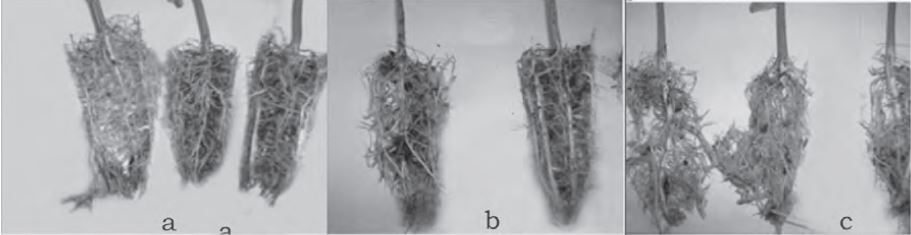
The aim of this study was to determine the physical properties of organic substrates in mixtures with biocharcoal as substrate-conditioner. The substrates used were sugar cane straw, peat, biocharcoal and volumetric mixtures with biocharcoal under a completely randomized treatment and ten replicates. We demonstrate the positive influence on the physical properties biocharcoal the substrates given by the decrease in soil density, average particle diameter and moisture retention of the blends relative to the individual components. Correspondence analysis shows a significant correlation (p ≤ 0,05) between the substrates and three nominal such as container removal capacity, stability and radical architecture of the root.
Downloads
Article Details

This work is licensed under a Creative Commons Attribution-NonCommercial 4.0 International License.
Those authors who have publications with this journal accept the following terms of the License Attribution-NonCommercial 4.0 International (CC BY-NC 4.0):
You are free to:
- Share — copy and redistribute the material in any medium or format
- Adapt — remix, transform, and build upon the material
The licensor cannot revoke these freedoms as long as you follow the license terms.
Under the following terms:
- Attribution — You must give appropriate credit, provide a link to the license, and indicate if changes were made. You may do so in any reasonable manner, but not in any way that suggests the licensor endorses you or your use.
- NonCommercial — You may not use the material for commercial purposes.
- No additional restrictions — You may not apply legal terms or technological measures that legally restrict others from doing anything the license permits.
The journal is not responsible for the opinions and concepts expressed in the works, they are the sole responsibility of the authors. The Editor, with the assistance of the Editorial Committee, reserves the right to suggest or request advisable or necessary modifications. They are accepted to publish original scientific papers, research results of interest that have not been published or sent to another journal for the same purpose.
The mention of trademarks of equipment, instruments or specific materials is for identification purposes, and there is no promotional commitment in relation to them, neither by the authors nor by the publisher.
How to Cite
References
Ansorena, M.J. 1994. Sustratos, propiedades y caracterización. España. Ediciones Mundi-Prensa. 172 p.
ASTM (E-29). 1972. Guidelines for establishing sieve analysis procedures. 50 p.
Castillo, M.I.C., et al. 2006. Evaluación de diferentes sustratos compuestos por cachaza como elemento principal en la producción de plantas de Eucaliptus grandis en contenedores. Revista Forestal Baracoa (CU) 25 (2):75-85.
Durenkamp, M., Luo, Y., Brookes, P.C. 2010. Impact of black carbon addition to soil on the determination of soil microbial biomass by fumigation extraction. Soil Biology Biochemical (EU) 42:2026–2029.
Glaser, B., Lehmann, J., Zech, W. 2002. Ameliorating physical and chemical properties of highly weathered soils in the tropics with charcoal a review. Biology Fertil. Soils (EU). 35:219–230.
Graber, E.R., et al. 2010. Biochar impact on development and productivity of pepper and tomato grown in fertigated soilless media. Plant Soil (NL) 337:481-496.
Guzmán, J.M. 2003. Sustratos y tecnología de almácigo. En: Memoria de cursos de producción en ambientes protegidos. UCR-CYTED. San José, Costa Rica. p 25.
Laird, D., et al. 2010. Biochar impact on nutrient leaching from a Midwestern agricultural soil. Geoderma (NL) 158:436–442. doi:10.1016/j.geoderma.2010.05.012
Madari, B.E. 2009. Matéria orgânica dos solos antrópicos da Amazônia (Terra Preta de Índio): sus características e papel na sustentabilidade da fertilidade do solo. In: Teixeira, W.G. et al. As terraspretas de índio da Amazônia: sua caracterização e uso deste conhecimento nacriação de novas áreas. Manaus: EMBRAPA Amazônia Ocidental. p. 174-187
Manejo en suelos y sustratos agrícolas. San José, Costa Rica. 23 p.
Novak, J.M., et al. 2010. Short-term CO2 mineralization after additions of biochar and switchgrass to a TypicKandiudult. Geoderma (NL) 154:281-288.doi:10.1016/j.geoderma.2009.10.014
Schmidt, M.W.I., Skjemstad, J.O., Gehrt, E., Kögel, K.I. 1999. Charred organic carbon in German chernozemic soils. European Journal of Soil Science (GB) 50:351–365.
Smith, L.J., Collins, P.H., Bailey, L.V. 2010. The effect of young biochar on soil respiration. Soil Biology and Biochemistry (US) 42:2345-2347.
Steiner, C., et. al. 2007. Long term effects of manure, charcoal and mineral fertilization on crop production and fertility on a highly weathered Central Amazonian upland soil. Plant and Soil (NL) 291:275-290.