Carbon retention by Integral Forest Enterprise Baracoa and its future evaluation
Article Sidebar
Main Article Content
Abstract
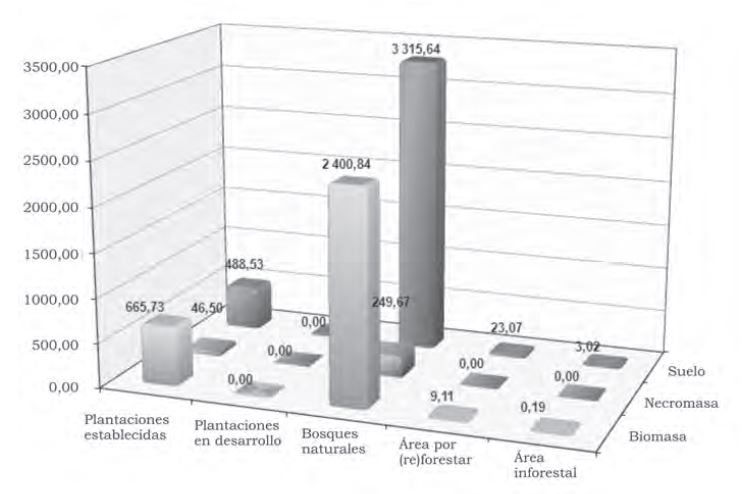
The results corresponding to the determination of the line base of retention of carbon of the Integral Forest Enterprise (EFI) Baracoa are presented starting from the current capacity of retention of carbon for one year bases, removed by established plantations, natural forests (for formation and category), area for (re)forestar and area inforestal. For the realization of this work leaves of the employment of the automated system Sumfor v-2.14. The reached results show that the biggest quantity of retained carbon is in the natural forests, and in a second place in the plantations. Also stands out the increase of the retention of carbon for the Enterprise in something more than 4292,91 kt of carbon for a 10 year period according to the line it bases projected.
Downloads
Article Details

This work is licensed under a Creative Commons Attribution-NonCommercial 4.0 International License.
Those authors who have publications with this journal accept the following terms of the License Attribution-NonCommercial 4.0 International (CC BY-NC 4.0):
You are free to:
- Share — copy and redistribute the material in any medium or format
- Adapt — remix, transform, and build upon the material
The licensor cannot revoke these freedoms as long as you follow the license terms.
Under the following terms:
- Attribution — You must give appropriate credit, provide a link to the license, and indicate if changes were made. You may do so in any reasonable manner, but not in any way that suggests the licensor endorses you or your use.
- NonCommercial — You may not use the material for commercial purposes.
- No additional restrictions — You may not apply legal terms or technological measures that legally restrict others from doing anything the license permits.
The journal is not responsible for the opinions and concepts expressed in the works, they are the sole responsibility of the authors. The Editor, with the assistance of the Editorial Committee, reserves the right to suggest or request advisable or necessary modifications. They are accepted to publish original scientific papers, research results of interest that have not been published or sent to another journal for the same purpose.
The mention of trademarks of equipment, instruments or specific materials is for identification purposes, and there is no promotional commitment in relation to them, neither by the authors nor by the publisher.
How to Cite
References
Álvarez, A., Mercadet, A. 2008. Puesta a punto del sistema automatizado SUMFOR v-2.0 hasta v2.14. Informe Final del Subproyecto: La mitigación del cambio climático por los bosques cubanos; Proyecto: Segunda Comunicación Nacional de Cambio Climático: Subsector Forestal; PRCT: Preservación de los Recursos Naturales. Instituto de Investigaciones Forestales. La Habana, 8 p.
Centella, A., Llanes, J., Paz, L. 2001. Primera Comunicación Nacional de Cuba a la CMNUCC. La Habana. INSMET. 169 p.
Cordero, E.M.; Mercadet, A.; Álvarez, A., Rodríguez, O. 2004. Estudio de caso sobre la mitigación del cambio climático por los bosques. La EFI Mayabeque de provincia Habana: Segunda aproximación. III Congreso Forestal de Cuba. (La Habana, 14-16 de septiembre: Palacio de las Convenciones) Cuba.
Díaz, F., Romero, E. 2000. Cuantificación y valoración económica de la captura de CO2 por plantaciones del género Eucalyptus establecido por el precio de las cuencas carboníferas del CESAR, IUFRO-RIFALC. Taller Internacional sobre Secuestro de Carbono. (Mérida, 16-20 de julio: Universidad de los Andes) Venezuela.
FAO. 2005. Situación de los Bosques del Mundo. Ed. FAO. Roma. Carbon Accounting Model for Forests [en línea]. Disponible en: http://www.greenhouse.gov.au/ncas/reports/ pubs/tr26final.pdf [Consulta 21 de mayo 2012].
Fonseca, W., Alice, F.E., Benayas, J.M.R. 2011. Carbon accumulation in aboveground and belowground biomass and soil of different age native forest plantations in the humid tropical lowlands of Costa Rica [en línea]. Disponible en: http: // www2.uah.es/josemrey/Reprints/Fonseca_CarbonAccumulationPlantations_NewForests_2011withcover.pdf [Consulta 21 de mayo 2012].
Kanninen, M. 2000. Secuestro de carbono en bosques, su papel en el ciclo global. Agroforestería para la producción animal en América latina-II. Sánchez, M.D y R. M. Dirección de Producción y Sanidad vegetal [en línea] Disponible en: http: // ftp.fao.org/docrep/fao/005/y4435s/y4435s00.pdf [Consulta: 13 de marzo 2011].
López, M., Koning, F., Paredes, H., Benítez, P. 2002. Estimación de carbono en biomasa de bosques secundarios y plantaciones forestales en el Noroccidental de Ecuador. Deutche Gasellschart fui Technische Zusammenarbeit (GTZ) GMBH. Eschborn. Alemania. 32 p.
López, C., et al. Gases Efecto Invernadero. Emisiones y Remociones, Cuba 1990-2002. ETGEI-Instituto de Meteorología, La Habana, junio de 2007. 27 p.
Moura, C.P. 2001. La Convención sobre el clima y el mercado de las contrapartes de las emisiones de carbono basadas en las actividades forestales. Unasylva (IT), 52 (206): 34-40.
Ramírez, O.A., Gómez, M. 1999. Estimación y valoración económica del almacenamiento de carbono. Forestal Centroamericana (CR) (27): 17- 22, julio-septiembre.
Rodríguez, P.E., Noa N., Leyva, G., Rodríguez, B. 2009. Proyecto de Ordenación y Desarrollo de la Economía Forestal (2008-2017) para la Empresa Forestal Integral Baracoa. Ministerio de la Agricultura. Grupo Empresarial de Agricultura de Montaña. 57 p.