Potentialities of Samanea saman and Enterolobium cyclocarpum in arboreal pasturages
Article Sidebar
Main Article Content
Abstract
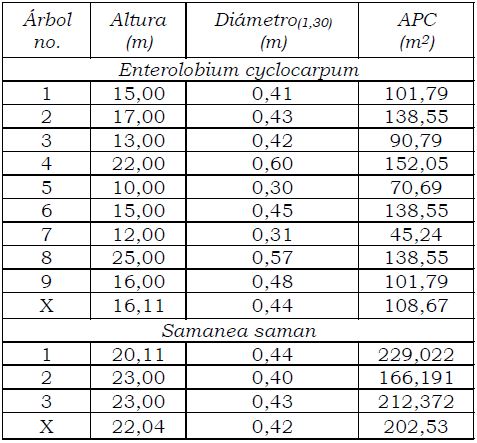
The results of an investigation are shown, developed during the period 2003-2004, in two forest species of multiple use: Samanea saman (Jacq.) Merril and Enterolobium cyclocarpum (Jacq.) Griss, these species are very distributed in the grasses areas of the country, especially S. saman. The works were developed in the area of Corralillo, municipality Guisa, Granma province, with the objective of determining the production of fruits with the use of collecting boxes, placed under the trees in four quadrants. The trees of S. saman with age among of 21 to 25 year, reached a yield of 1.5 t/ha/years, while mature trees of E. cyclocarpum with 25 years, they add a production of 0.9 t/ha/years., both species offer their fruits in the most critical months in the dry period (February-April), when the natural grasses are scarce. In spite of this in the central region of Cuba, trees of Samanea saman and Enterolobium cyclocarpum with more than 20 years of age, reached a production of 0.63 and 0.86 t/ha/years respectively.
Downloads
Article Details

This work is licensed under a Creative Commons Attribution-NonCommercial 4.0 International License.
Those authors who have publications with this journal accept the following terms of the License Attribution-NonCommercial 4.0 International (CC BY-NC 4.0):
You are free to:
- Share — copy and redistribute the material in any medium or format
- Adapt — remix, transform, and build upon the material
The licensor cannot revoke these freedoms as long as you follow the license terms.
Under the following terms:
- Attribution — You must give appropriate credit, provide a link to the license, and indicate if changes were made. You may do so in any reasonable manner, but not in any way that suggests the licensor endorses you or your use.
- NonCommercial — You may not use the material for commercial purposes.
- No additional restrictions — You may not apply legal terms or technological measures that legally restrict others from doing anything the license permits.
The journal is not responsible for the opinions and concepts expressed in the works, they are the sole responsibility of the authors. The Editor, with the assistance of the Editorial Committee, reserves the right to suggest or request advisable or necessary modifications. They are accepted to publish original scientific papers, research results of interest that have not been published or sent to another journal for the same purpose.
The mention of trademarks of equipment, instruments or specific materials is for identification purposes, and there is no promotional commitment in relation to them, neither by the authors nor by the publisher.
How to Cite
References
Betancourt, A. 2000: Árboles maderables exóticos de Cuba Ed. Científico-Técnica, La Habana, 117 p.
Bisse, J. 1988: Árboles de Cuba, Ed. Científico-Técnica, La Habana, 226 p.
Calzadilla, E. et al. 2005: «Informe final proyecto sobre la aplicación de técnicas agroforestales en zonas con limitaciones productivas» (resultados de investigación), PRCT 09.12, La Habana, 37 p.
Calzadilla, E. 2002: «Tecnología 70. Establecimiento y manejo de unidades silvopastoriles con ganado bovino de ceba», Instituto de Investigaciones Forestales, La Habana, 5 p.
CITMA. 2004: «Base de datos», Red provincial de meteorología.
CITMA. 2001: Paquete profesional Statistica, versión 6,0 para Windows 2000.
Combe, S.; Budowski, G. 1979: «Clasificación de las técnicas agroforestales: una revisión de literatura», Actas. Turrialba. Taller de Sistemas Agroforestales en América Latina, pp. 17-47.
MINAG. 1995: Nueva clasificación genética de los suelos, Instituto de Suelos, La Habana, p. 62.
Mosqueda, A. 2004: «Sistemas agrosilvopastoriles (finca Díaz Cuevas)», Informe Técnico Parcial (PRCT-09-14), Estación Experimental Forestal Placetas, Instituto de Investigaciones Forestales, La Habana, 4 p.
Renda, A.; Calzadilla, E.; Jiménez, M.; Sánchez, J. 1997: La agroforestería en Cuba. Resultados de investigaciones silvopastoriles, FAO, Santiago de Chile, pp. 43-50.
Santiesteban, R. et al. 2005: «Respuesta de variedades de garbanzo (Cicer arietinum Lin.) en un agroecosistema premontañoso de la provincia de Granma», revista Centro Agrícola (CU). 32: 4, oct.-dic.