Contribution to the study of the epiphytes as non-timber forest product of cultural value
Article Sidebar
Main Article Content
Abstract
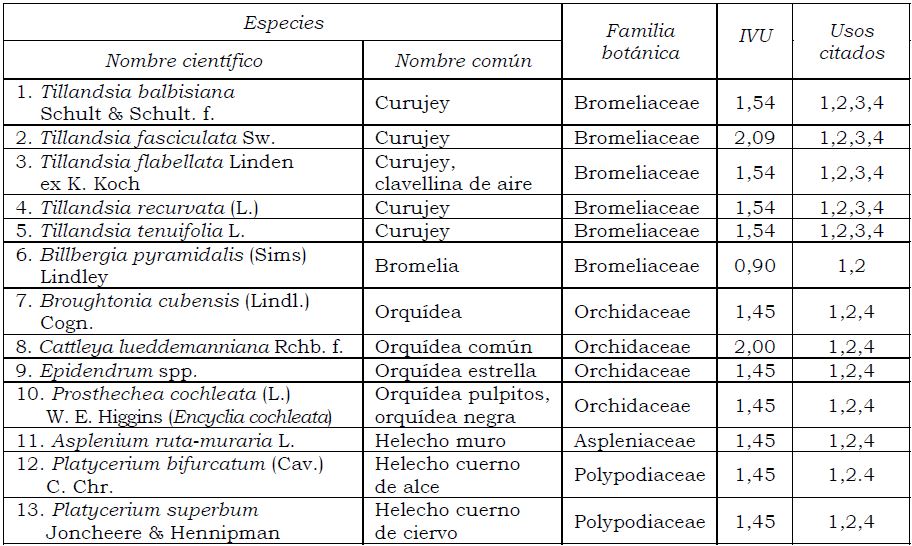
The marketed freely species of epiphytes of cultural value are identified and the marketing of the same ones is characterized, being valued the incidence of certain physiologic aspects of the species and some human activities on the base of the resource, to define elements that contribute to the sustainable management of this Non-Wood Forest Product of the Cuban forests. 13 species of epiphytes were identified, distributed in some botanical families. Tillandsia fasciculata is reported like the more numeric frequency and the most usual in the commercialization. The results of the realized interviews resume the reported uses in four use categories settled down: (1) ornamental use, (2) cultivate independent, (3) medicinal use, (4) religious labours. The Value Index of General Use calculated for each species express the importance and the consent grade in the use of the same ones for all the interviewees.
Downloads
Article Details

This work is licensed under a Creative Commons Attribution-NonCommercial 4.0 International License.
Those authors who have publications with this journal accept the following terms of the License Attribution-NonCommercial 4.0 International (CC BY-NC 4.0):
You are free to:
- Share — copy and redistribute the material in any medium or format
- Adapt — remix, transform, and build upon the material
The licensor cannot revoke these freedoms as long as you follow the license terms.
Under the following terms:
- Attribution — You must give appropriate credit, provide a link to the license, and indicate if changes were made. You may do so in any reasonable manner, but not in any way that suggests the licensor endorses you or your use.
- NonCommercial — You may not use the material for commercial purposes.
- No additional restrictions — You may not apply legal terms or technological measures that legally restrict others from doing anything the license permits.
The journal is not responsible for the opinions and concepts expressed in the works, they are the sole responsibility of the authors. The Editor, with the assistance of the Editorial Committee, reserves the right to suggest or request advisable or necessary modifications. They are accepted to publish original scientific papers, research results of interest that have not been published or sent to another journal for the same purpose.
The mention of trademarks of equipment, instruments or specific materials is for identification purposes, and there is no promotional commitment in relation to them, neither by the authors nor by the publisher.
How to Cite
References
Barraza, L.; Pineda, J. 2003: «Cómo ven los bosques los jóvenes mexicanos: comparación de dos comunidades», revista Unasylva (IT) 54 (2): 10-17, abril.
Díaz, M. A. 1988: Las orquídeas nativas de Cuba, Ed. Científico-Técnica, La Habana, 63 pp.
Mondragón, D.; Villa Guzmán, D. M. 2008: «Estudio etnobotánico de las bromelias epifitas en la comunidad de Santa Catarina Ixtepeji, Oaxaca, México», revista Polibotánica (MX), no. 026: 175-191, octubre.
Pierce, A. R. 2002: «Helechos mango de violín (Matteucia struthiopteris)», Explotando el mercado verde, certificación y manejo de Productos Forestales No Maderables, Serie Pueblos y Plantas, Fondo Mundial para la Naturaleza, cap. 14, pp. 170-174.
Pierce, A. R.; Shanley, P. 2002: «Aspectos ecológicos». Explotando el mercado verde, certificación y manejo de Productos Forestales No Maderables, Serie Pueblos y Plantas, Fondo Mundial para la Naturaleza, cap. 26, pp. 269-283.
Roig y Mesa, J. T. 1974: Plantas medicinales, aromáticas o venenosas de Cuba, Instituto del Libro, La Habana, 1150 pp.
Toscano González, J. 2006: «Uso tradicional de plantas medicinales en la vereda San Isidro, municipio de San José de Pare Boyacá: un estudio preliminar usando técnicas cuantitativas», htto://bases.bireme.br/cgi-bin/wxislind.exe/iah/ online/?IsisScript=iah/iah.xis&src=google&base=LILACS &lang=p&nextAction=Ink&exprSearch=469086&indexSearch=ID.
Vale, Á. 1997: «De orquídeas, significados y modos», revista Se Puede Vivir en Ecópolis (CU), Fundación de la Naturaleza y el Hombre, La Habana, pp. 24-28, junio.
Wolf, J. H. D.; Cornelis, J. F. K. 2002: «Recolección sustentable de bromelias epifitas en las tierras altas de Chiapas, México: un estudio piloto», Explotando el mercado verde, certificación y manejo de Productos Forestales No Maderables, Serie Pueblos y Plantas, Fondo Mundial para la Naturaleza, cap. 24, pp. 260 y 261.