Prelimary results of the analogy forestry in the Guantánamo province
Article Sidebar
Main Article Content
Abstract
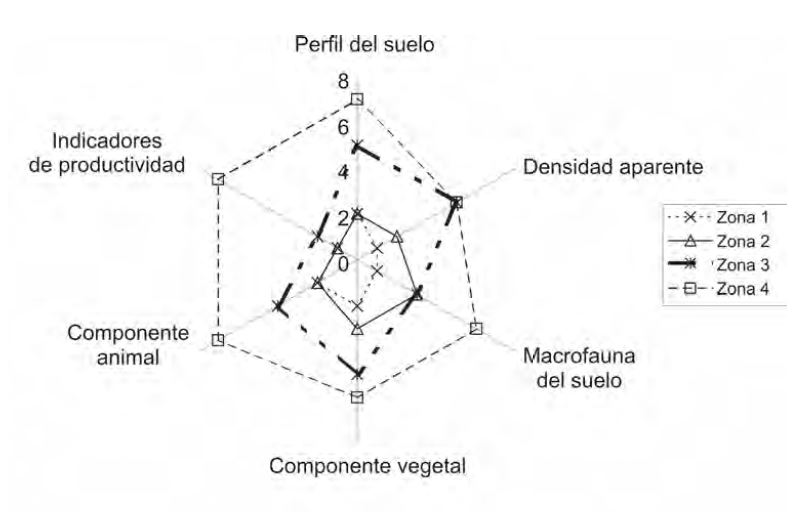
The study was carried out on the forest farms (1, 2, 4 and 14) of the Silvicultural (Forestry) Unit Guantánamo, belonging to the Integral Forest Company Guantánamo. The study is being developed with the technological approach of Analogy Forestry: A silvicultural (forestry) tool, used to design and create stable ecosystems that sustain and increase the natural resources and the ecological services of an ecosystem. With this, it is possible to obtain an integral evaluation of the areas, the physiognomic formula of the existent vegetation and the ecological appraisal with their corresponding analyses. In general, it was observed in the case study carried out on the Farm number one that the zone 4 had the better conditions as seen by the development of their canopies, this zone can be taken as a reference, to be copied in other zones.
Downloads
Article Details

This work is licensed under a Creative Commons Attribution-NonCommercial 4.0 International License.
Those authors who have publications with this journal accept the following terms of the License Attribution-NonCommercial 4.0 International (CC BY-NC 4.0):
You are free to:
- Share — copy and redistribute the material in any medium or format
- Adapt — remix, transform, and build upon the material
The licensor cannot revoke these freedoms as long as you follow the license terms.
Under the following terms:
- Attribution — You must give appropriate credit, provide a link to the license, and indicate if changes were made. You may do so in any reasonable manner, but not in any way that suggests the licensor endorses you or your use.
- NonCommercial — You may not use the material for commercial purposes.
- No additional restrictions — You may not apply legal terms or technological measures that legally restrict others from doing anything the license permits.
The journal is not responsible for the opinions and concepts expressed in the works, they are the sole responsibility of the authors. The Editor, with the assistance of the Editorial Committee, reserves the right to suggest or request advisable or necessary modifications. They are accepted to publish original scientific papers, research results of interest that have not been published or sent to another journal for the same purpose.
The mention of trademarks of equipment, instruments or specific materials is for identification purposes, and there is no promotional commitment in relation to them, neither by the authors nor by the publisher.
How to Cite
References
Betancourt, A. 1999: Silvicultura especial de árboles maderables tropicales, Ed. Científico-Técnica, La Habana, 427 pp.
Red Internacional de Forestería Análoga. 2008a: «Manual práctico de Forestería Análoga», Ed. Quito, Ecuador, 38 pp.
Red Internacional de Forestería Análoga. 2008b: «La gran guía de la Forestería Análoga», Ed. Centro Falls Brook Centre, Canadá, 21 pp.
Sánchez, R. et al. 2008: «Informe de suelo realizado a tres fincas forestales (1, 2 y 14) del Paraguay», Centro Provincial de Suelos, Guantánamo, Cuba, 10 pp.
Senanayake, R.; Beehler, B. M. 2000: Forest Gardens: Sustaining Rural Communities Around the World Through Holistic Agro Forestry, 2nd ed., Sustainable Development Internacional, IGC Publ., Londres, pp. 95-98.
Fundación Rescate del Bosque Tropical. 2001: «Manual práctico de Forestería Análoga», FRBT, Ecuador, 38 pp.