Evaluación del carbón vegetal obtenido a partir de residuos maderables de pino
Article Sidebar
Main Article Content
Abstract
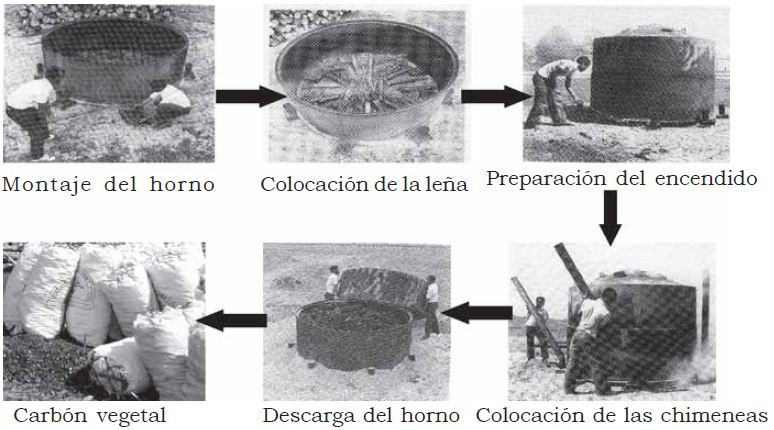
The objective of the work is to evaluate the obtained charcoal starting from wood-derived wastes and industrial so that it facilitates to give a productive use to the waste. The characteristics of the obtained charcoal of wood-derived wastes coming from pruning areas are presented and of the industry of the species Pinus caribaea Morelet Barri and Golfari (var. caribaea), Pinus tropicalis Morelet and a mixture of both species by means of the employment of metallic ovens and traditional oven.
It is carried out the characterization of the end product according to the established norms and the obtained parameters are compared with the literature. It was found that the analyzed charcoal present good quality, for what they can be employees as much for domestic use as in the industry. It was proven that it is possible the use of the metallic oven for the carbonization of pruning wastes and sawmill, since is an efficient operation from the point of view of the yield of charcoal and of the humanization of the work. It also presents advantages in relation to the traditional oven in the related with technical, social, economic and environmental functions.
Downloads
Article Details

This work is licensed under a Creative Commons Attribution-NonCommercial 4.0 International License.
Those authors who have publications with this journal accept the following terms of the License Attribution-NonCommercial 4.0 International (CC BY-NC 4.0):
You are free to:
- Share — copy and redistribute the material in any medium or format
- Adapt — remix, transform, and build upon the material
The licensor cannot revoke these freedoms as long as you follow the license terms.
Under the following terms:
- Attribution — You must give appropriate credit, provide a link to the license, and indicate if changes were made. You may do so in any reasonable manner, but not in any way that suggests the licensor endorses you or your use.
- NonCommercial — You may not use the material for commercial purposes.
- No additional restrictions — You may not apply legal terms or technological measures that legally restrict others from doing anything the license permits.
The journal is not responsible for the opinions and concepts expressed in the works, they are the sole responsibility of the authors. The Editor, with the assistance of the Editorial Committee, reserves the right to suggest or request advisable or necessary modifications. They are accepted to publish original scientific papers, research results of interest that have not been published or sent to another journal for the same purpose.
The mention of trademarks of equipment, instruments or specific materials is for identification purposes, and there is no promotional commitment in relation to them, neither by the authors nor by the publisher.
How to Cite
References
Alonso, Gisela: «Entre todos podemos», periódico Juventud Rebelde, La Habana, 2001.
Bailey, G. H.: «A Simplified Method of Sampling
Logging Residue», The Choonible, vol. 46, no. 4:1-7, Canadá, 1970.
Batista, C.; D. A. Amparo; Raisa Domínguez: «Disponibilidad y uso de la biomasa como fuente potencial de productos químico de la República Dominicana», Indotecnia 7 (3):23-26, 1995.
Bequette, F.: «Un mundo sin desechos, ¿una utopía?», revista Correos (49): 43-48, 1996.
Doat, J.; F. Petroff: «La carbonisation des bois tropicaux», Revue Bois et Forest des Tropiques (159):55-72, 1975.
FAO: Métodos simples de carbón para fabricar carbón vegetal, FAO, Roma, 1983.
––––:. Red de cooperación en Dendroenergía. (17):1-20, 1997.
Guyat, Ma. Antonia; Nieves Barrios: «Bosques energéticos. Tecnología industrial para producción de carbón vegetal», conferencia, Minag, La Habana, 1991.
Guyat, Ma. Antonia; R. Sánchez: «Especies con perspectiva para la producción de carbón vegetal y activado», I Activo de Carbón Activado, La Habana, 1991.
Guyat, Ma. Antonia; D. Velázquez; V. Capote; K. Manzanares: «Valoración energética de algunos residuos en un aserradero de la provincia de Pinar del Río», Revista Forestal Baracoa 24 (2) 51-56, 2005.
IPCC: Segunda evaluación cambio climático, PNUMA, 1995.
NC 580-2008. Carbón vegetal. Especificaciones.
Padilla Adriana; Judith, Petit; Delfina Padilla; Lucy Quintero: «Especies usadas como combustible en la comunidad de Villanuev», Revista Forestal Venezolana 44(1):11-15, 2000.
Soto Sandoval, J. A.; J. A. Aguirre; J. Méndez; G. Páez: «Evaluación económica y ambiental de residuos maderables en aserraderos de Costa Rica», Revista Forestal Centroamericana 2329, 2000.
UNE-32001- 81. Hulla y antracita. Determinación de la humedad total.
UNE-32004- 84. Combustibles minerales sólidos. Determinación de cenizas.
UNE-32019-84. Combustibles minerales sólidos. Determinación de materias volátiles.
Velázquez, Digna; Katia Manzanares; Ma. Antonia Guyat: «Rendimiento de materia prima en un aserradero de la provincia de Pinar del Río, Cuba», Revista Forestal Baracoa 25(1):97-104, 2006.
Vidal, A.; J. Rodríguez; H. Gra; J. M. Montalvo: «Modelos matemáticos de biomasa aprovechable de copa de coníferas en la provincia de Pinar del Río», IIF, La Habana, 1994.
Wolf, F.; E. Vogel: «Características del carbón de algunas especies maderables del noroeste de México», Ciencia Forestal 11(59):181-186, 1986.