Respuesta fenológica de Juglans jamaicensis subsp. jamaicensis al aumento de la temperatura en bosque pluvial montano
Article Sidebar
Main Article Content
Abstract
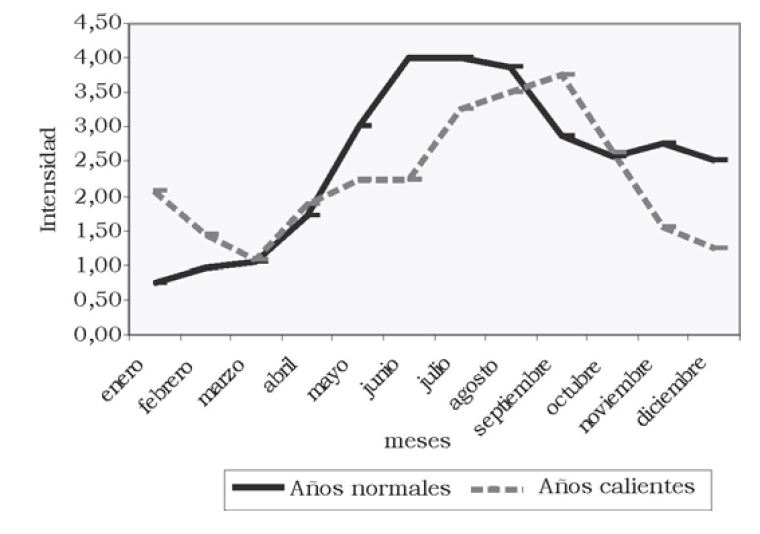
The importance of to evaluate and to give pursuit to aspects that demonstrate the impacts of the climatic change on the forests has become a necessity. The study of the phenology of the trees and the function of the temperature in the modification of the cycle phenological are one of the biggest challenges in the field of the investigation. The objective of the work is to identify the alterations caused by the increase of the minimum temperature on the phenological pattern of Juglans jamaicencis C.DC. subsp. jamaicensis (nogal del país), endemic of the Mayors Antilles of mountainous areas during the years 1992 and 1999 of Topes of Collantes in Guamuhaya. The importance is valued that has it for its adaptation and future handling. The phenological pattern of J. jamaicensis was analyzed in the normal years and hot years. Phenological alterations took place in the species, being that in J. jamaicensis these alterations were of importance in the reproductive activity what can commit their future capacity of adaptation. It is reported a study complete phenology of this taxon for the first time in Topes of Collantes.
Downloads
Article Details

This work is licensed under a Creative Commons Attribution-NonCommercial 4.0 International License.
Those authors who have publications with this journal accept the following terms of the License Attribution-NonCommercial 4.0 International (CC BY-NC 4.0):
You are free to:
- Share — copy and redistribute the material in any medium or format
- Adapt — remix, transform, and build upon the material
The licensor cannot revoke these freedoms as long as you follow the license terms.
Under the following terms:
- Attribution — You must give appropriate credit, provide a link to the license, and indicate if changes were made. You may do so in any reasonable manner, but not in any way that suggests the licensor endorses you or your use.
- NonCommercial — You may not use the material for commercial purposes.
- No additional restrictions — You may not apply legal terms or technological measures that legally restrict others from doing anything the license permits.
The journal is not responsible for the opinions and concepts expressed in the works, they are the sole responsibility of the authors. The Editor, with the assistance of the Editorial Committee, reserves the right to suggest or request advisable or necessary modifications. They are accepted to publish original scientific papers, research results of interest that have not been published or sent to another journal for the same purpose.
The mention of trademarks of equipment, instruments or specific materials is for identification purposes, and there is no promotional commitment in relation to them, neither by the authors nor by the publisher.
How to Cite
References
Baeubien, E. G.; H. J. Freeland:.«Spring Phenology Triends en Alberta, Canadá: Links to Ocean Temperatura», 1987.
Berazaín, R.; F. Areces, J. C. Lazcano Y R. González: «Lista roja de la flora vascular cubana», Revista Jardín Botánico Atlántico 4, 2005.
Betancourt, A.: Silvicultura especial de árboles maderables tropicales, Ed. Científico-Técnica, La Habana, 2000.
Bolin et al.: .Segunda evaluación cambio climático. Panel Intergubernamental sobre cambio climático (IPCC). 1995.
Del Risco, E.; D. Vandama: «Regionalización florística de Cuba», Nuevo Atlas Nacional de Cuba,
X.2.4.II, 1989.
Gutiérrez, J.; A. Centella; M. Lima: «Impactos del cambio climático en Cuba», Revista de Información Científica y Tecnologías 6(1):26-36, 2001.
Hechavarría, O.: «Aspectos metodológicos sobre la fenología en especies forestales», Boletín de Mejoramiento Genético y Semillas Forestales del Catie, 20:15, 1998.
Hno. León Y Hno. Alaín: Flora de Cuba, Suplemento, La Habana, 1974.
Jiménez, M.: «¿Un futuro caliente?», suplemento científico-técnico de Juventud Rebelde, La Habana, 11 de marzo del 2007.
May, T.: «Tres años de observaciones fenológicas en el bosque nublado de Casabito (reserva científica Ébano Verde, Cordillera Central, RD. Revista Moscosoa 10:164-178.
Menzel, A.: «Trends in Phenological Phases in Europe Between 1951 y 1996», Int. J.
Biometeorol. 44 (2):76-81, 2000.
Rubbelke, D.: «Economía ambiental y cambio climático», curso de verano, Universidad de La Habana, 2000.
Schaarschmidt, D.: «Die karebasche Juglans-Sippezwei. Subespecoies Woissenschftliche Zeitschrift»,. Matcg-Naturwiiss. 32(6):895-898, Fiedrich-Schiller-Univ Jena, 1983.
SERVICIO ESTATAL FORESTAL: Ley Forestal de Cuba, Reglamento, 1999.