SUPERVIVENCIA DE ESPÉCIES LEÑOSAS NATIVAS CULTIVADAS EN SUELOS DEGRADADOS
Article Sidebar
Main Article Content
Abstract
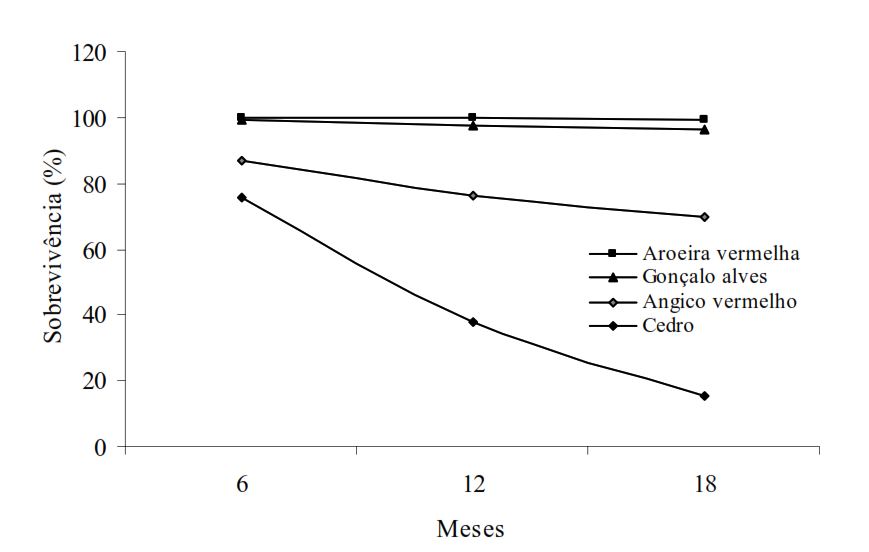
The decrease of the natural forest cover without the inclusion of a criteria and sustainability indicators determines losses on biodiversity. Therefore, some field alternatives such as the seedling of native woody species should have to be applied, looking for conservation and reduction of the pressure and demand for native tropical forests. The target of this study was the evaluation of the survival and the silvicultural behavior of the native woody species in mixed crop with full solar radiation. This research was conducted in a degraded area at the Universidade Federal do Recôncavo da Bahia (UFRB), Cruz das Almas, Brazil, evaluating the survival of the following species: angico (Anadenanthera macrocarpa Benth), aroeira vermelha (Schinus terebinthifolius Radii), cedro (Cedrela fissilis Vell.) and gonçalo alves (Astronium fraxinifolium Schott.), all of them of multiple use, in mixed crop. The experimental design was focused in casual blocks with four replications, in subdivided alternated spots. The plants were produced in the greenhouse at the Agriculture, Environmental and Biological Sciences Center at the UFRB and sown in mixed plant system, in alternated lines, with a measuring of 3,0m x 1,5m; 3,0m x 2,0m; 3,0m x 2,5m and 3,0m x 3,0m. The experiment evaluated the survival at the age of 6, 12 and 18 months. The specie aroeira and gonçalo as well, shown better survival percentages, being increased in comparison with the others evaluated species. Those species has the capacity of adaptation to the climatic conditions of the area. The performance of the angico could be consider regular, therefore, the cedro express low survival (15,1%), at the age of 18 months. Finally, the research of the survival shows the efficiency in the determination of the establish potential of the studied species.
Downloads
Article Details

This work is licensed under a Creative Commons Attribution-NonCommercial 4.0 International License.
Those authors who have publications with this journal accept the following terms of the License Attribution-NonCommercial 4.0 International (CC BY-NC 4.0):
You are free to:
- Share — copy and redistribute the material in any medium or format
- Adapt — remix, transform, and build upon the material
The licensor cannot revoke these freedoms as long as you follow the license terms.
Under the following terms:
- Attribution — You must give appropriate credit, provide a link to the license, and indicate if changes were made. You may do so in any reasonable manner, but not in any way that suggests the licensor endorses you or your use.
- NonCommercial — You may not use the material for commercial purposes.
- No additional restrictions — You may not apply legal terms or technological measures that legally restrict others from doing anything the license permits.
The journal is not responsible for the opinions and concepts expressed in the works, they are the sole responsibility of the authors. The Editor, with the assistance of the Editorial Committee, reserves the right to suggest or request advisable or necessary modifications. They are accepted to publish original scientific papers, research results of interest that have not been published or sent to another journal for the same purpose.
The mention of trademarks of equipment, instruments or specific materials is for identification purposes, and there is no promotional commitment in relation to them, neither by the authors nor by the publisher.
How to Cite
References
ALVINO, F. de O. Influência do espaçamento e da cobertura do solo com leguminosas sobre o crescimento do Schizolobium amazonicum Huber ex. Ducke (paricá). UFRA, 2006. 77 fl. Dissertação (Mestrado) Universidade Federal Rural da Amazônia. Belém, PA. mar. 2006.
ANTEZANA, F. L. Crescimento inicial de 15 espécies nativas do bioma Cerrado sob diferentes condições de adubação e roçagem, em Planaltina – DF. UnB, 2008. 104 fl. Dissertação (Mestrado) Universidade de Brasília, DF. fev. 2008.
ARAÚJO, F. S. et al. Florística da vegetação arbustivo-arbórea colonizadora de uma área degradada por mineração de caulim, em Brás Pires, MG. Revista Árvore, Viçosa, MG, v. 29, n. 6, nov/dez. 2005.
BAGGIO, A. J. Aroeira como potencial para usos múltiplos na propriedade rural. Boletim de Pesquisa Florestal, Colombo, PR. n.17, p.25-32, dez. 1988.
BOTELHO, S. A.; DAVID, A. C.; FARIA, J. M. R. Desenvolvimento inicial de seis espécies florestais nativas em dois sítios, na região sul de Minas Gerais. Revista Cerne, Lavras, MG, v. 2, n. 1, p. 43-52, 1996.
CARVALHO, P. E. R. Competição entre espécies florestais nativas em Irati - PR, cinco anos após o plantio. Boletim de Pesquisa Florestal, Colombo, PR, n. 2, p. 41-56, jun. 1981.
COUTINHO, M. P. ; MARTINS, S. V. ; BARROSO, D. G. ; COUTINHO, R. P. ; Marciano,C.R. . Sobrevivência e crescimento inicial de espécies arbóreas nativas no enriquecimento de floresta secundaria em Cruzeiro-SP. In: SIMPÓSIO NACIONAL SOBRE RECUPERAÇÃO DE AREAS DEGRADADAS, 5, 2002, Belo Horizonte-MG. Anais... Editora Folha de Viçosa Ltda., 2002. p. 271-273.
CUNHA, A. O. et al. Efeito de substratos e das dimensões dos recipientes na qualidade de Tabebuia impetiginosa (Mart. Ex D. C.) Standl. Revista Árvore. Viçosa – MG, v. 29, n. 4, p. 507-516, 2005.
LORENZI, H. Árvores brasileiras – Manual de identificação e cultivo de plantas arbóreas nativas do Brasil. Nova Odessa, SP. Instituto Plantarum, v. 2, p. 384. 2000.
KNOWLES, O. H. e PARROTTA, J. A. Amazon forest restoration: an innovative system for native species selection based on phenological data and field performance indices. Commonwealth Forestry Review. v. 74, n. 3, p.230-243, 1995.
MACEDO, L.G. et al. Desenvolvimento inicial de três espécies florestais em áreas de pastagem degradada em Ijaci-MG. Brasil Florestal, v. 23, n.79, p.71-76, abr. 2004.
MACHADO, J. A. R.; BACHA, C. J. C. Análise da rentabilidade econômica dos reflorestamentos com essências nativas brasileiras: o caso do Estado de São Paulo. Revista de Economia e Sociologia Rural, Brasilia, DF. v. 40, n.3. 2002.
MELOTTO, A. M. et al. Sobrevivência de espécies florestais nativas do Brasil central introduzidas em pastagem de Brachiaria brizantha cv. Marandu. In: CONGRESSO NACIONAL DE BOTÂNICA, 56. 2005, Curitiba. Anais... Curitiba: Sociedade Botânica do Brasil, 2005. 1 CD. PINTO, A. F. & RODIGHERI, H. R. Reflorestamento misto de espécies florestais nativas a pleno sol na região do Norte Pioneiro do Estado do Paraná. Colombo, PR: Embrapa Florestas, 2001. (Comunicado técnico, 56).
SERRÃO, D. R.; JARDIM, F. C. da S.; NEMER, T. C. Sobrevivência de seis espécies florestais em uma área explorada seletivamente no município de Moju, Pará. Revista Cerne, Lavras, v.9, n.2, p. 153-163, jul./dez. 2003.
SILVA, J. C. S. Desenvolvimento inicial de espécies lenhosas, nativas e de uso múltiplo na recuperação de áreas degradadas de cerrado sentido restrito no Distrito Federal. 2007.
fl. Dissertação (Mestrado) Universidade de Brasília. Brasília, DF, 2007.
SOARES FILHO, W. S. et al. Parentais femininos monoembriônicos na obtenção de portaenxertos híbridos de citros. Revista Brasileira de Fruticultura, Jaboticabal, SP, v. 30, n. 1, p. 215-218, mar. 2008.
SOUZA, C. R. et al Desempenho de espécies florestais para uso múltiplo na Amazônia. Scientia Forestales, Piracicaba, SP. v. 36, n. 77, p. 7-14, mar. 2008.
TONINI, H.; ARCO-VERDE, M. F.; SA, S. P. P. Dendrometria de espécies nativas em plantios homogêneos no Estado de Roraima- Andiroba (Carapa guianensis Aubl), Castanha-do-Brasil (Bertholletia excelsa Bonpl.), Ipê-roxo (Tabebuia avellanedae Lorentz ex Griseb) e Jatobá (Hymenaea courbaril L.). Acta Amazônica, Boa Vista, RR. v. 35, n. 3, p. 353-362, jul/set. 2005.