Empleo de la roca zeolita cubana como sustrato sólido para la reproducción del hongo ectomicorrizógeno Pisolithus tinctorius
Article Sidebar
Main Article Content
Abstract
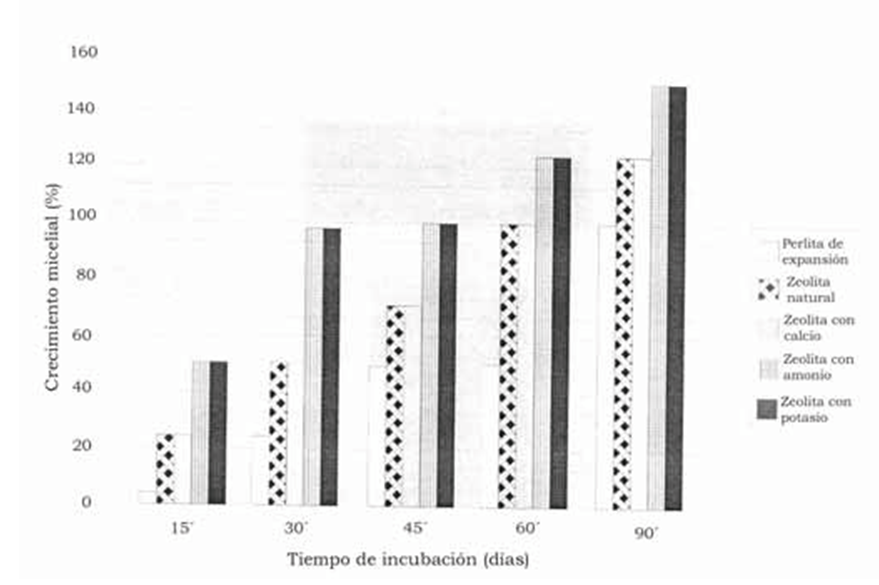
The artificial introduction of ectomycorrhizal fungus in forestry nurseries, can be done by massive reproduction of vegetative micelium, using a solid sustrate like perlite of expansive. It was studied the growth and development micelial of the fungal species Pisolithus tinctorius, using as like support the cuban zeolític rock: natural and modified by ionic exchange with ammonium, potassium and calcium. An increment was obtained in the growth rate and micelial density of the mycorrhizal species supported in the zeolitic rock.
Downloads
Article Details

This work is licensed under a Creative Commons Attribution-NonCommercial 4.0 International License.
Those authors who have publications with this journal accept the following terms of the License Attribution-NonCommercial 4.0 International (CC BY-NC 4.0):
You are free to:
- Share — copy and redistribute the material in any medium or format
- Adapt — remix, transform, and build upon the material
The licensor cannot revoke these freedoms as long as you follow the license terms.
Under the following terms:
- Attribution — You must give appropriate credit, provide a link to the license, and indicate if changes were made. You may do so in any reasonable manner, but not in any way that suggests the licensor endorses you or your use.
- NonCommercial — You may not use the material for commercial purposes.
- No additional restrictions — You may not apply legal terms or technological measures that legally restrict others from doing anything the license permits.
The journal is not responsible for the opinions and concepts expressed in the works, they are the sole responsibility of the authors. The Editor, with the assistance of the Editorial Committee, reserves the right to suggest or request advisable or necessary modifications. They are accepted to publish original scientific papers, research results of interest that have not been published or sent to another journal for the same purpose.
The mention of trademarks of equipment, instruments or specific materials is for identification purposes, and there is no promotional commitment in relation to them, neither by the authors nor by the publisher.
How to Cite
References
CASTELLANO, A.; R. MOLINA: «Mycorrizae», The Con- tainer Tree Nursery Manual, USDA For. Service, Washigton, D. C., Vol. 5. Agric. Handbook 674 : 101-167, 1989.
FERRER, A.; T. CABRERA; S. HERRERA: «Perspectivas para la utilización de las micorrizas ectótrofas en el cultivo de Pinus caribaea var. caribaea», Revis- ta Forestal Baracoa 17 (2):97-107, 1987.
GARBAYE, J.: «Les plantations forestieres tropicales: un champ d‘application priviligie pour la mycorhization controles», Bois et Forest des Tropiques no. 216:1-17, 1988.
GARDNER, J.; N. MALAJZUCK: «Recolonizations of rehabilited bauxite mine sites in Western Austra- lia by mycorrhizal fungi», For. Ecol. Management 24: 27-42, 1988.
HERRERO, G.; A. GONZÁLEZ-ABREU; C. ROMERO: Estu- dio de factibilidad económica y científico-técnica del resultado: utilización de la zeolita natural y mo- dificada en la reforestación, Monografía, Instituto de Investigaciones Forestales, La Habana, 1994.
MALAJZUCK N.; P. REDELL; M. BRUNDRETT: «Role of Ectomycorrhizal Fungi in Minesite Reclamation», American Phytopathological Soc.: 83-103, 1994.
MARX, D. H.; W. C. BRYAN: «Pure Culture Synthesis of Ectomycorrhizae by Telephora terrestris and Pisolithus tinctorius on Different Conifer Host», Can. J. Bot. 48: 639-643, 1970.
MARX, D. H.; W. C. BRYAN: «Growth and Ectomy- corrhizal Development of Loblolly Pine Seedlings in Fumigated Soils Infested with the Fungal Symbiont Pisolithus tinctorius», Forest Sci. 21:245-254, 1975.
MERCADET, A.; A. GONZÁLEZ-ABREU; J. A. MARTÍNEZ; P. ROMERO: «Primeras experiencias en el em- pleo de zeolita para la producción de posturas de Pinus caribaea var. caribaea destinadas a la reforestación de sabana serpentinosa en Camagüey», Revista Forestal Baracoa 20 (2):
-87, 1990.
PEÑA-PUENTE, F.: «Estandarización de un medio de cultivo para la propagación masiva de hongos ectomicorrícicos», Rev. Ciencia Forestal, vol.1, marzo-abril, no. 18:11-20, 1979.
PERA, J.; J. PARLADÉ; I. ÁLVAREZ: «Eficacia del tipo de inóculo de Pisolithus tinctorius en la formación de micorrizas en Pinus pinaster y Pseudotsuga menziesii», Invest. Agrar., Sist. Recur. For. 3(1): 1-12, 1994.
SWART, W. J.; J. M. THERON: «Future Needs of Mycorrhizal Research in South African Forestry», South African Forestry Journal no. 153:31-35, 1990.
WILSON, G. P.; F. A. MUMPTON: Zeo-Agriculture: Use of Natural Zeolites in Agriculture and Aquaculture, International Committes on Natu- ral Zeolites, 1984.